Sunday, December 29, 2024

Tested: 1962 BMW R27


Tested: 1962 BMW R27

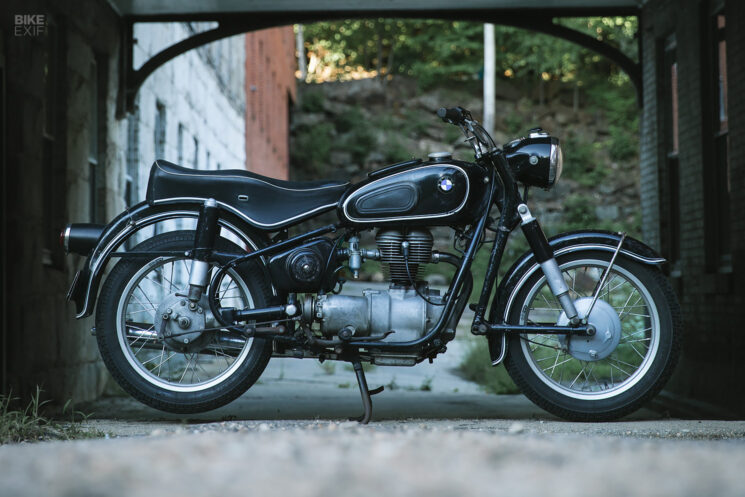
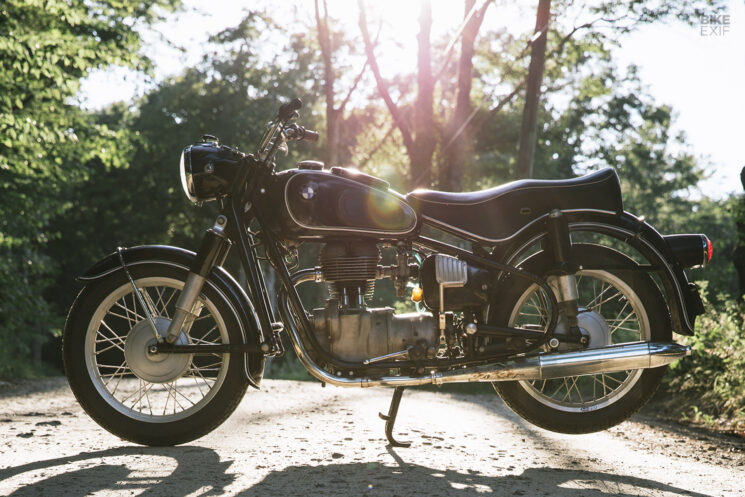
1962 BMW R27
The R27 showed up in the stable courtesy of our good friend and artist Christopher Myott. It’s a DeLorean, an underpowered time machine that couldn’t hit 88 mph if my life depended on it. And though the records may show a top speed of 81 mph, I managed to hit 70 and it was reaching. Given that it’s 54 years old and 250 cc, expecting it to do much more than maintain 55 mph is asking a lot, and it did that without complaint. Ultimately, my experience of the bike is more reverence than critique. What it lacks in power and all-around performance, it makes up for with character and charm, which shone through in unexpected ways.

Over time, I began to actually appreciate its overtaxed 18 hp single. It allowed me to focus on riding by completely removing from the equation my temptation to fool around. With nothing to prove, I would get from A to B at the R27’s pace, and because showing off was not an option, I was able to relax and adjust my expectations of not only the bike, but of myself.

1962 BMW R27
The R27’s characteristics are quirky, counterintuitive, and oddly reassuring. Though the bike is (and feels) underpowered, it’s not lacking in applied ingenuity and it puts a smile on my face with every dogged crank of the throttle.

Words by Gregory Moore | This article first appeared in issue 024 of Iron & Air Magazine, and is reproduced here under license.

Sidecar Subject: 1962 BMW R27

Engine:
Single-cylinder, four-stroke
Displacement: 250 cc
Compression ratio: 8.2:1
Transmission: Four-speed, left foot shift
Horsepower: 18 hp @7,400 rpm
0-60: A long time

Chassis:
Frame: Steel cradle
Front suspension: Earles fork
Rear suspension: Dual shocks
Brakes: Dual Drums

Dimensions and Weight:
Wheelbase: 54.3 inches
Weight: 365 lb (Wet)
Fuel Tank Capacity: 4.0 gallons

Significance: The 1962 BMW R27 was a landmark in BMW’s lineup as the last single-cylinder model, combining refined engineering with features like a rubber-mounted engine for reduced vibrations, marking the end of an era in the brand’s single-cylinder touring motorcycles.

Saturday, December 28, 2024

The Trophy Rat: An All-Conquering Rat Rod from America’s Northwest


The Trophy Rat: An All-Conquering Rat Rod from America’s Northwest

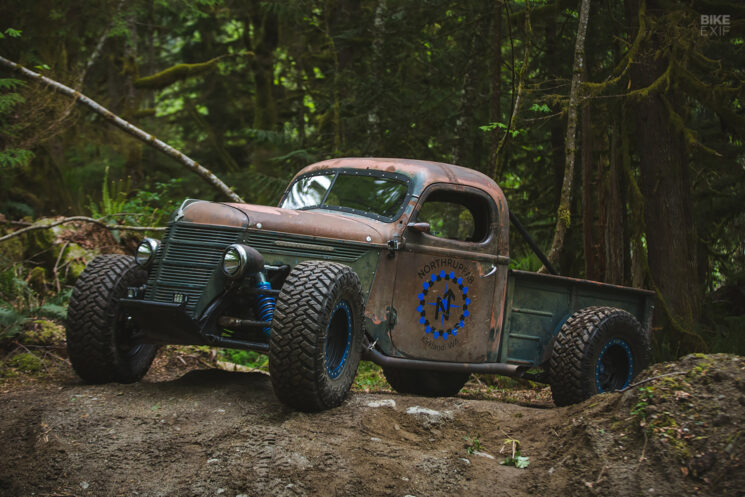
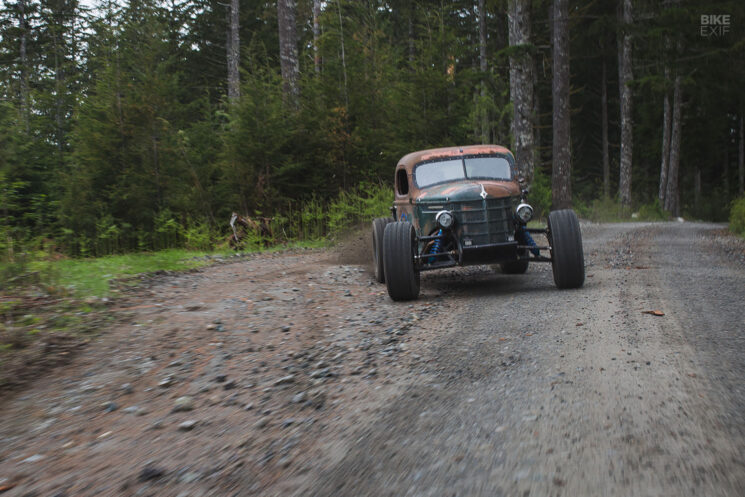
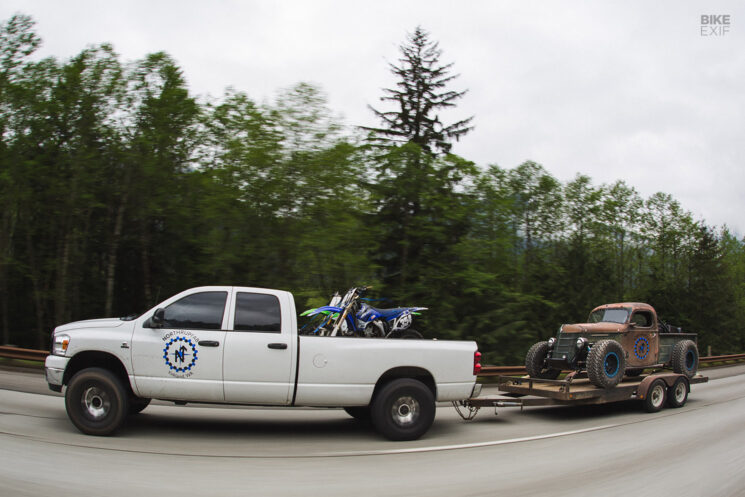
Keith Northrup's Trophy Rat
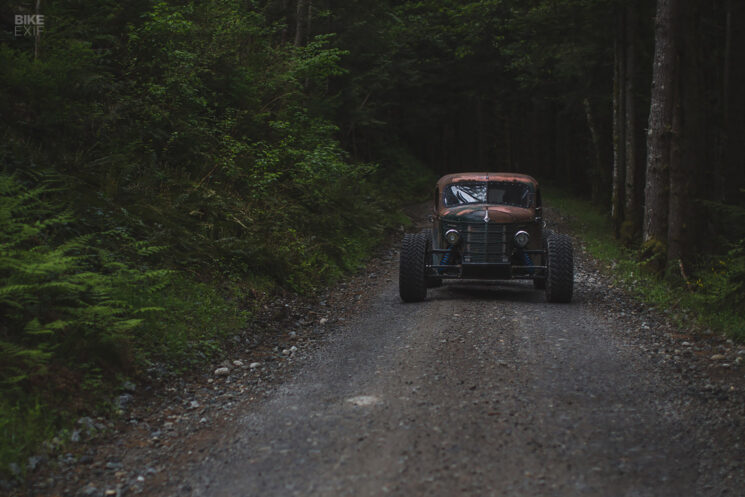
Kirkland, known as the “The Little City That Could,” is eight miles from metropolitan Seattle. Its claim to fame is that Costco formerly called it home and used the town for inspiration when it came time to name its in-house line of products. Kirkland is a charming and quaint Washington town where you wouldn’t expect to see a ’34 International chop rod – let alone one with LED headlights, piggyback off-road suspension, and the V-8 from a mid-’00s Corvette – but it’s where Keith Northrup, the builder of the car you see here, has lived for over 20 years.

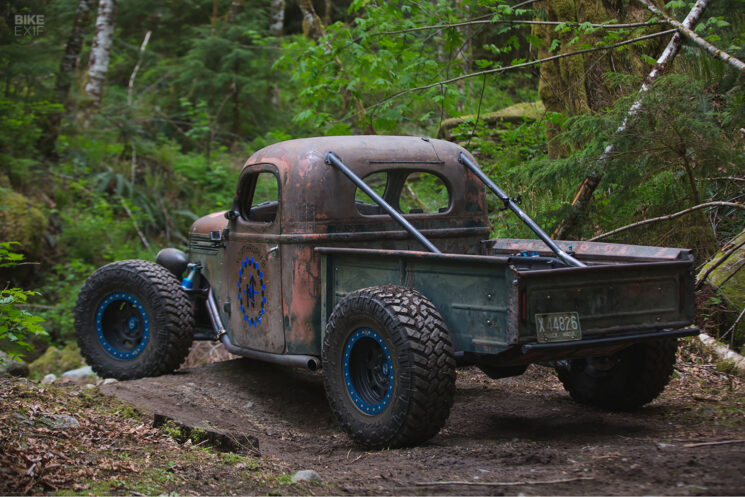
Keith Northrup's Trophy Rat
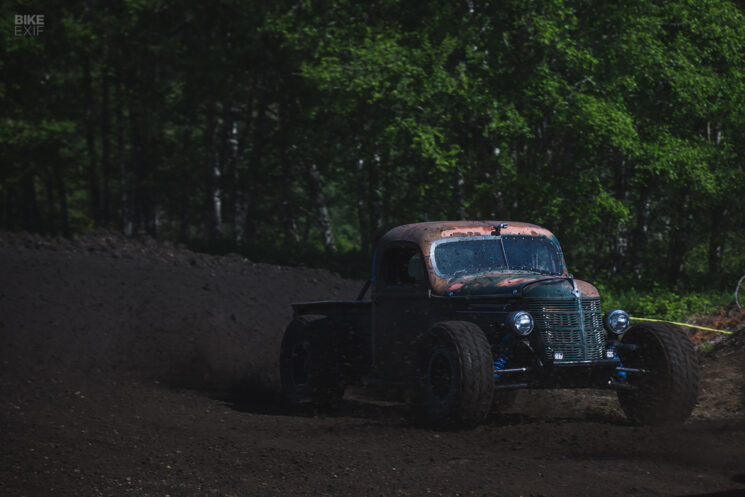
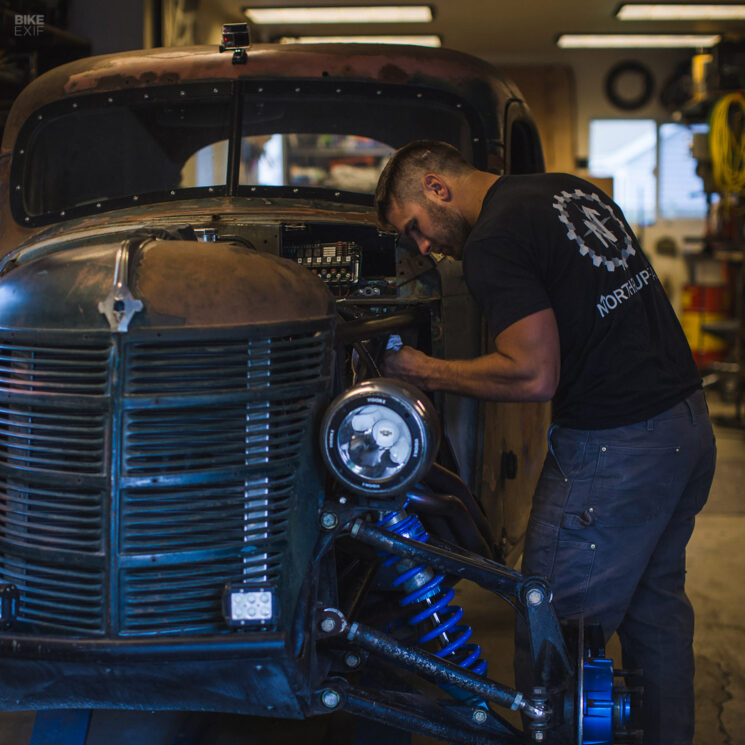
The 32-year-old husband and father works out of his 950-square-foot home garage and lines his pockets by building furniture and doing other specialized metal work, a skill he started to hone at 16 while working on his ’84 Toyota pickup. Northrup began competitive off-road rock crawling at age 20 and has been building tube-chassis toys ever since. This project, Trophy Rat, is far different from the many projects that preceded it. Whereas past undertakings were trail-crawling four-by-fours, the Trophy Rat takes the best bits from trophy trucks, rat rods, and sports cars, and assembles them in a way that turns a jalopy into something brutal and imposing that won’t shy away from anything. Northrup simply calls it an “everything rig.” He says it’s his best build yet.

Keith Northrup's Trophy Rat
“You get people from every realm who like it,” he says. “From off-roaders to hot rod enthusiasts to the old, mustached ‘Timber Tamer’ guy that’s out there just loving the old iron. The old guys that are the hardest to impress will talk your ear off now.” Northrup wasn’t looking to build the Trophy Rat, but a buddy needed to unload a beat-up ’34 International, so Northrup obliged and let the corroded cab sit in his garage until he could figure out what to do with it. Seeing how it’s such a rare and distinctive truck, Northrup felt like he needed to do a special build that didn’t cut any corners and stayed true to the original while inventing a new aesthetic and improving performance in every aspect of the vehicle.

Keith Northrup's Trophy Rat
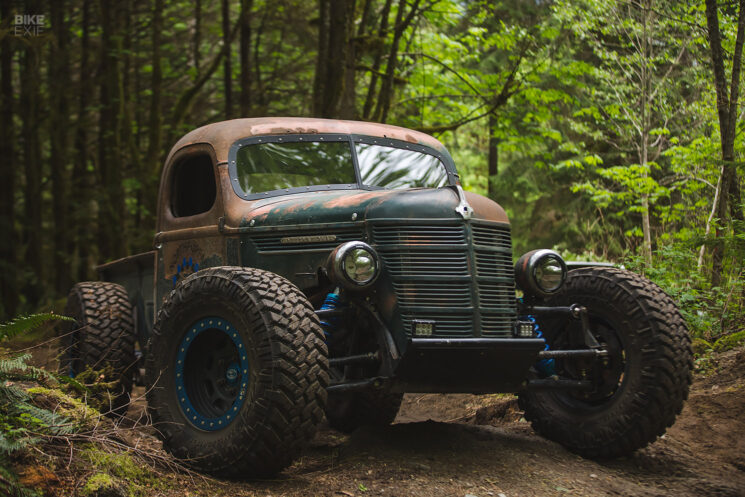
Northrup did things he’d never tried before, like cutting eight inches from the bottom of the steel body, shortening the bed by a foot, and carefully chopping four inches from the roof without making the rear window look wonky and disproportional. He tucked in the side windows a bit, repurposed original metal where he could, and TIG-welded everything so the new body lines stayed as sharp as possible.

Keith Northrup's Trophy Rat
The reworked body didn’t mesh with the stock chassis, so Northrup threw out the frame, went with what he knew, and fabbed an all-new tube chassis for the truck. It was a long, tedious process made worse by the fact that Northrup still had to create custom suspension arms to accommodate the King off-road dampers with remote reservoirs, weld long-tube headers that would hang off the long-block V-8, and scratch-build a slew of other odds and ends to cinch the build together. But three years and $50,000 later, he pulled the bows tight on the Trophy Rat.

Keith Northrup's Trophy Rat
It’s scruffy and proudly wears decades of patina, but the build itself is very clean. Little has been overlooked, and what at first seems to be haphazardly assembled slowly comes into view as thoughtful and meticulously formed. It’s a machine that blends off-color beauty with stunning, raw performance. The entire body can be removed from the tube chassis in about an hour, not unlike a trophy truck, and 315 horsepower hits the ground after being sent from the 5.7-liter V8 through a Turbo 400 three-speed automatic transmission to the rear differential. “I didn’t want to go four-wheel drive,” says Northrup, “because I didn’t want to blow up a thousand dollars worth of axles every time we went out, so we stayed simple with rear-wheel drive, and I think we nailed it pretty good.”

Keith Northrup's Trophy Rat
That’s surprising, seeing as how Washington’s wet, mossy environment and the truck’s bead-locked wheels wrapped in 35-inch Nitto Mud Grappler tires scream out that this a four-wheel drive vehicle. But it’s less surprising if you ask Northrup about his driving style: “Just hit stuff really fast and try not to crash.”

It’s hard not to like Northrup. It gets even harder after asking him about his plans for the truck. “If we have it around long enough, it’ll be Sage’s – our son’s – first car.” Sage is a year old. If he’s anything like his dad, though, in fifteen years he’ll be driving the Trophy Rat around Kirkland, The Little City That Could.

Keith Northrup's Trophy Rat

This article first appeared in issue 024 of Iron & Air Magazine, and is reproduced here under license.

Words by Chris Nelson | Images by Michael Sol Sproehnle & Shawn Howe

Friday, December 27, 2024

Safety’s Off: KC Kawano’s White Knuckle Bobber


Safety’s Off: KC Kawano’s White Knuckle Bobber

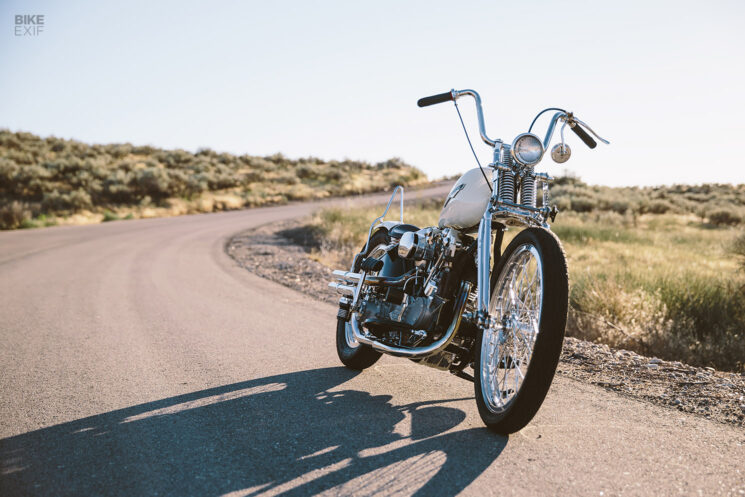
White Knuckle Knucklehead Bobber by KC Kawano
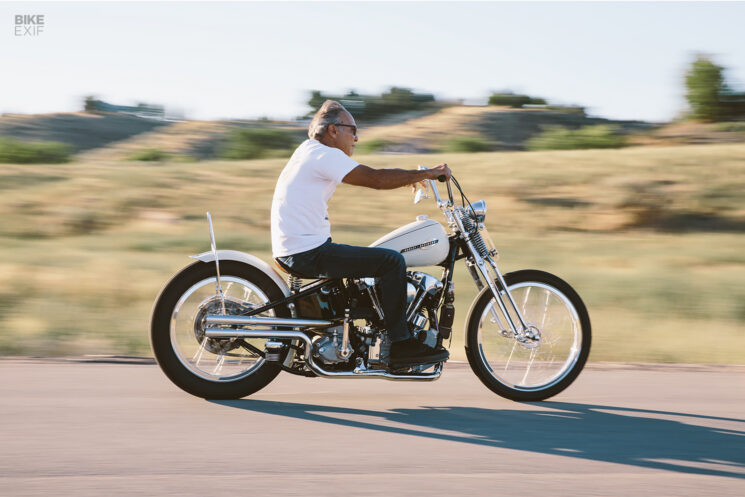
When I think of a bobber, a “bob-job,” a “cut-down,” a “chopper,” or whatever the hell you want to call it, this is what I think of: straightforward, low-slung, powerful, knuckles up, dangerous as all fuck, and American as a heart attack.

This fine specimen was built by KC Kawano over the course of one winter to exacting specifications: his own. He is a man of few words, but his work speaks for itself. He didn’t build the bike to talk about it. He built it to ride it.

White Knuckle Knucklehead Bobber by KC Kawano
When we take into account that KC is an old-school hot-rod builder, and we stand that next to the Knucklehead, we can surmise a pretty good idea of the intention: build an American custom that would capture the spirit of the 1950s.

What we now consider the bobber was born in the 1930s. These early customs, known as “cutdowns,” began as a way to breathe new life into aging motorcycles and mimicked the styles seen on the race track. Depression-era riders stripped the bikes of their accouterments, tossed the fenders, and junked everything else that didn’t either make the bike run or roll. This resulted in a much faster and much more stylish ride. All it took was a little bit of inspiration and some elbow grease. Besides, at that time, elbow grease and inspiration were about all anyone had.

White Knuckle Knucklehead Bobber by KC Kawano
When people are forced to reconsider the things they have, not the things they want, an otherwise inaccessible well of ingenuity becomes available.

The years that followed the end of WWII saw a marked rise in the popularity of the custom motorcycle. Soldiers returned from the war, the economy rebounded, and the “cut-down” evolved into the “bob-job.” The extra scratch gave builders the means to apply more distinctive paint jobs, add chrome, and make other unique customizations to their bikes. This gave rise to what we see here – a near-textbook example of the “bobber.”

White Knuckle Knucklehead Bobber by KC Kawano
Clean, simple, crisp – adjectives that are so ubiquitous that they could be used to describe just about anything. An apple. Maybe a cold pop on a sunny day. And definitely this ’50s-inspired Knucklehead bobber. It’s not meant to set the world of custom motorcycles ablaze, to take home trophies, or to bolster KC’s “insta-fame.” It’s meant to be the kind of bike where the question of whether or not there should be a front brake was never a question at all. How else would it earn its name?

White Knuckle Knucklehead Bobber by KC Kawano
KC’s White Knuckle is a reflection of himself. No frills. It’s the opposite of grandiose, long-winded, and hyperbolic. So when KC answers the question of where the bike came from with a terse, “from here and there,” it’s a refreshing honesty. Maybe things just aren’t that complicated sometimes. And maybe, just maybe, many more things in life would be better off considered just the same.

This article first appeared in issue 024 of Iron & Air Magazine, and is reproduced here under license.

Words by Gregory George Moore | Images by Jeff Stockwell

*Since the original publication of this piece by Iron & Air, KC Kawano passed away in Idaho at 67 years of age. Ride in Peace KC.*

White Knuckle Knucklehead Bobber by KC Kawano

Sidecar Subject: ‘White Knuckle’ Harley-Davidson Knucklehead Bobber

Owner: KC Kawano

Make/Model: Harley-Davidson Knucklehead (various years)

Fabrication: Shawn Rodgers

Assembly: KC Kawano with help from Shawn and Phil

Engine: 93″ S&S Knucklehead. Oversized valves ported by Lee Wickstrom at Knucklehead Theology. S&S Super E Carburetor

Transmission: Baker 6-speed in 4-speed case

Exhaust: Fabricated by Shawn 

Frame: HD wishbone, I-Beam Springer Forks

Wheels: Aluminum 21″ Front, Aluminum 19″ Rear

Tires: Pirelli MT66 Front, Heidenhau K34 Rear

Brakes: HD Mechanical Rear

Fuel Tank: Newer HD bagger tank sectioned and narrowed 4.5″

Handlebars: Wrecked Metals, Bates reproduction Headlight

Paint: Dale at Body and Paint Boise with Graphics by Bob Von Shaw at Smith Signs Boise

Special thanks: Thanks to Shawn, Phil, Brad, Dale, and Von Shaw

White Knuckle Knucklehead Bobber by KC Kawano

Monday, December 23, 2024

This vivid Royal Enfield Bobber is a tasty technicolor treat

This vivid Royal Enfield Bobber is a tasty technicolor treat

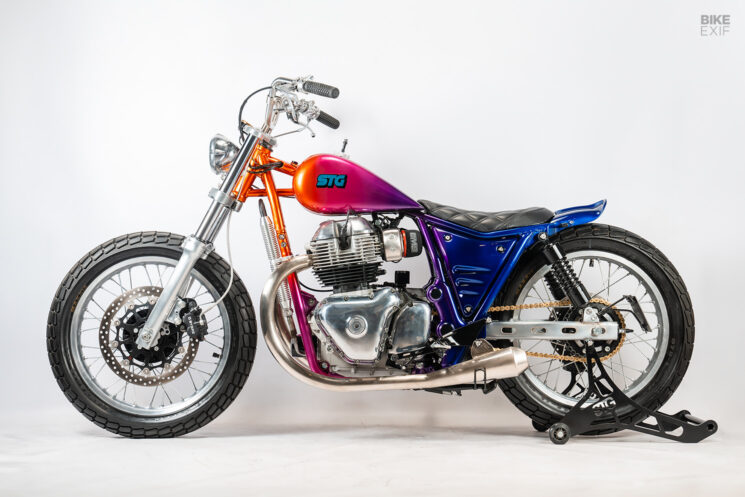
Royal Enfield Interceptor 650 bobber by STG Tracker
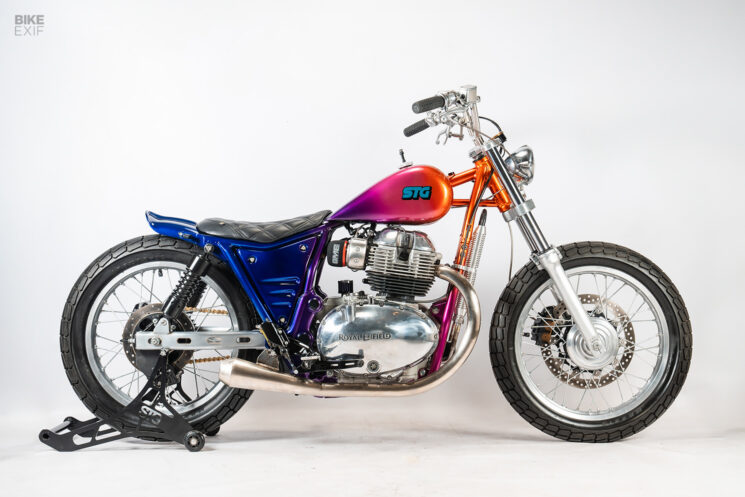
STG Tracker is one of the most versatile custom workshops in operation today. The Argentine duo of Marcelo Obarrio and Germán Karp works on myriad makes and models, constantly flitting between different build styles. So if you give them carte blanche on a project, you can bet they’ll deliver something highly imaginative—like a Royal Enfield bobber with a bespoke frame and a dazzling livery.

The Royal Enfield Interceptor 650 [known as the INT650 in the USA] is a cracking donor bike for a custom build. It’s not crazy expensive, its parallel twin engine is easy to get along with, and it looks great out of the box with lots of room for tweaking. But for Marcelo and Germán, this particular project called for something more…
Royal Enfield Interceptor 650 bobber by STG Tracker
“A client came to us asking to make a bobber out of his Interceptor 650, but it had to be different,” Marcelo tells us. “For this, he gave us the freedom to make whatever we want.”

“What Germán and I really like are Japanese-style bobbers—but in this case, we shook it up a little. Our goal was that everything on this build had to be as customized as possible. And if we used an original part, we had to modify it.”
Royal Enfield Interceptor 650 bobber by STG Tracker
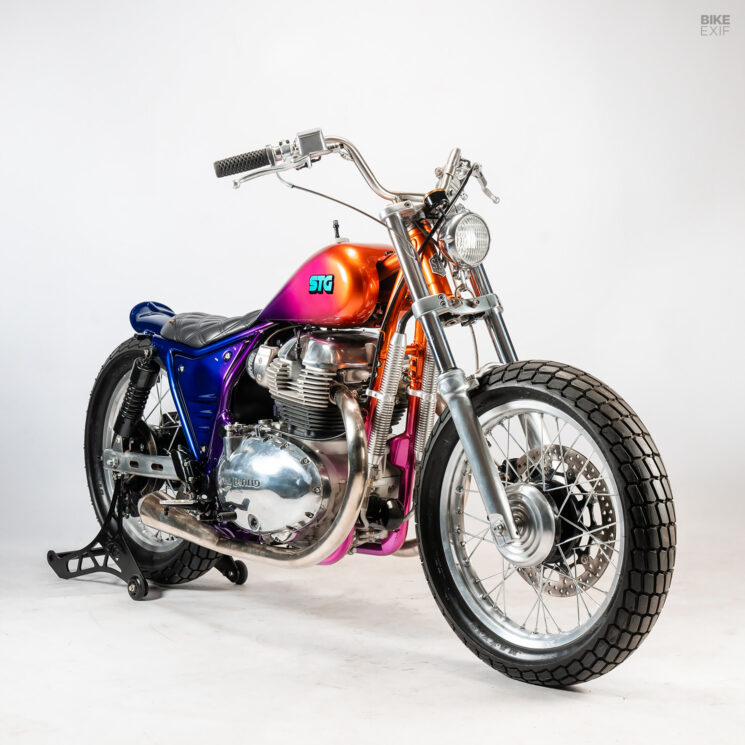
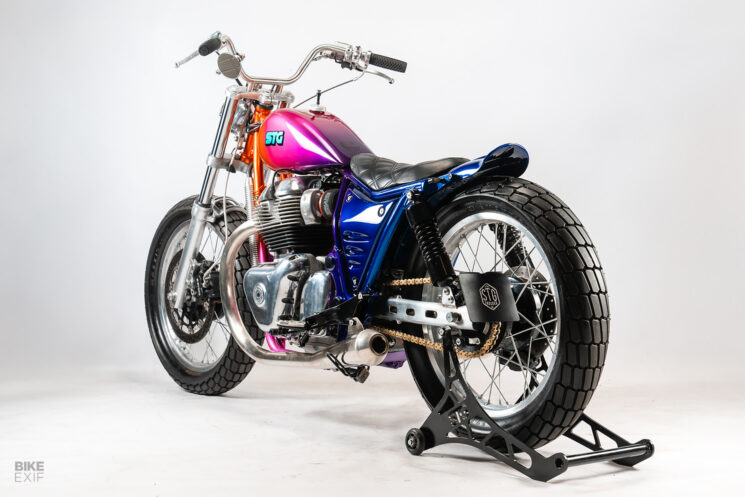
To achieve their vision, STG Tracker stripped the Royal Enfield Interceptor 650 down to its bones and began cutting up its frame. By the time they were done, all that was left was the original steering neck and frontal down tubes. Everything else is new, fabricated out of tubular steel to create a more retro look than the original square-section backbone.

STG retained the original forks, but polished the lowers and the stock yokes. The custom frame dips towards the rear tire, where it’s propped up on a short pair of aftermarket shocks. The bike now rolls on 19” aluminum rims—adding a measure of equilibrium to this bobber’s deliberate nose-up stance.
Royal Enfield Interceptor 650 bobber by STG Tracker
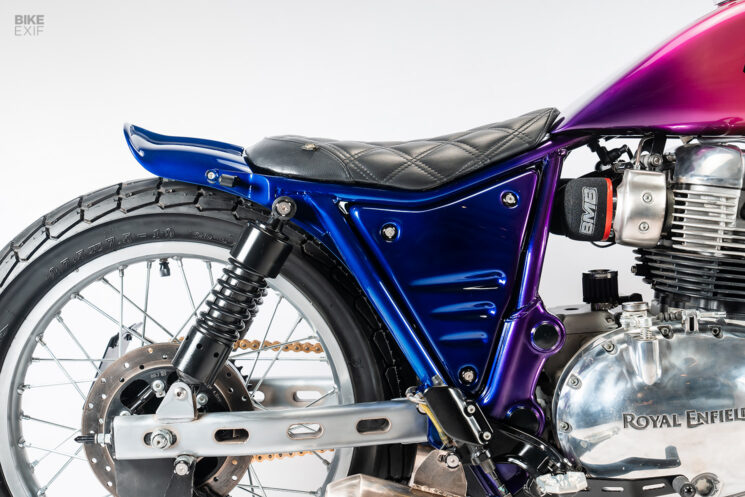
Next, STG cut slots into the OEM swingarm, welding fresh material into the inside of each one. The idea was to radically change the swingarm’s look without sacrificing strength. The slotted design is repeated on the front fork brace and the foot controls, which also wear chunky STG Tracker pegs.

The guys also flipped the rear brake caliper to position it under the hub and rerouted the brake line through the swingarm. There’s another nifty detail up front, in the form of a billet aluminum hub cover on the wheel’s non-braking side.
Royal Enfield Interceptor 650 bobber by STG Tracker
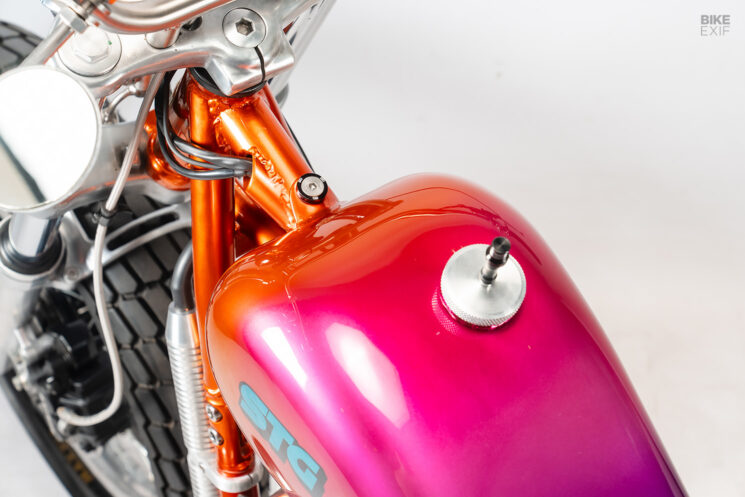
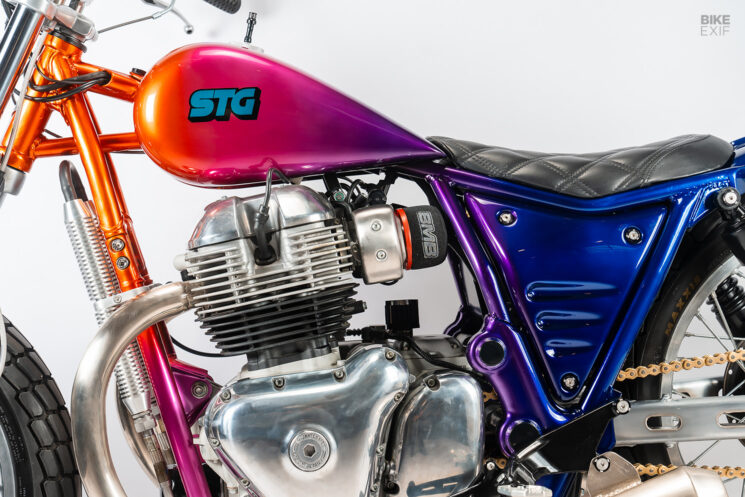
Moving to the bodywork, STG shaped a small teardrop fuel tank out of steel. Its size left little room for the bike’s fuel pump—or an adequate amount of fuel. So the duo built a second fuel cell under the seat to house the pump and carry extra fuel, bringing the total capacity to almost 9 liters [2.38 gallons].

The Enfield’s triangular side covers were inspired by the Harley FXR. STG shaped them out of fiberglass over a handmade mold. The leather seat is a one-off, as is the ribbed rear fender.
Royal Enfield Interceptor 650 bobber by STG Tracker
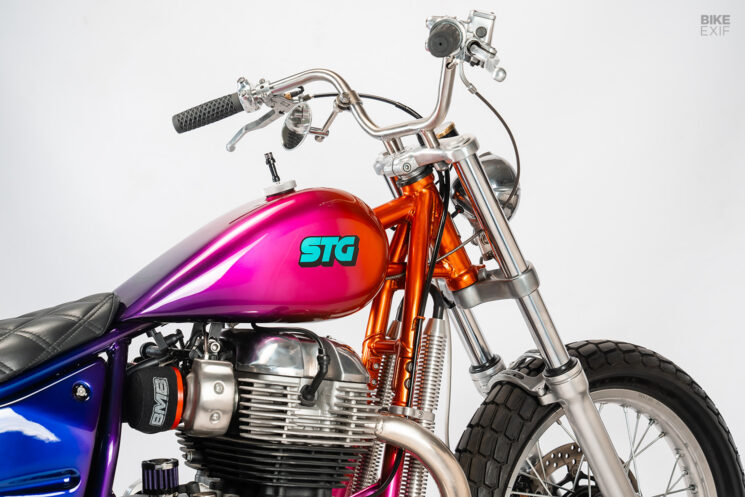
There’s more of Marcelo and Germán’s handiwork in the cockpit. Handmade stainless steel handlebars with integrated risers are bolted to the top yoke, and fitted with custom aluminum switchblocks that feature integrated LED warning lights. ODI x Cult Vans ‘waffle’ grips adorn the bars too.

All the wiring runs through the bars, before routing around the steering neck and into a channel in the frame. Other details include a Motogadget speedo, and a small chopper-style headlight on a custom-made stainless steel bracket. LED turn signals at the back double up as taillights.
Royal Enfield Interceptor 650 bobber by STG Tracker
STG Tracker chose not to mess with the Enfield’s 646 cc mill—but they did add BMB pod filters and a custom twin exhaust system. “The engine has good torque and it’s reliable,” Marcelo explains. “So we just mapped it to make it breather better with the air filters and exhaust.”

“What we didn’t like at all was the oil radiator—just a square black piece, ruining everything. Looking at what old Harleys use, we made two separate round aluminum radiators. They work great, functionally, and they look f**king good!”
Royal Enfield Interceptor 650 bobber by STG Tracker
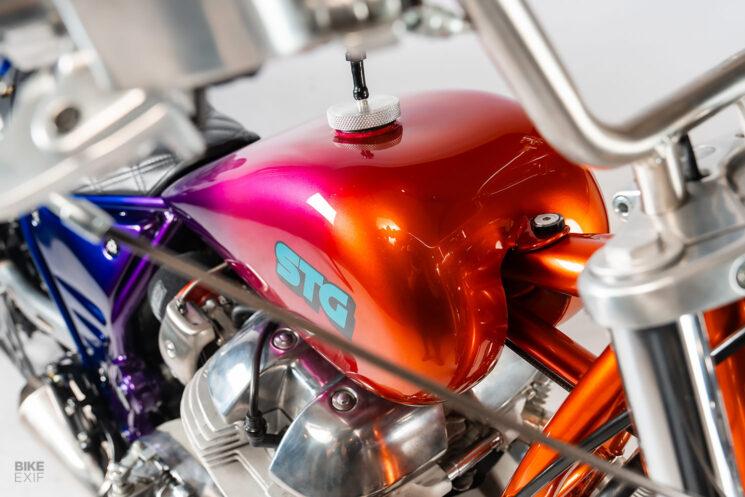
When it came time to paint their latest creation, STG decided to attempt something they’d never done before, by matching the bodywork and frame paint, inch for inch. “The color scheme was inspired by the Californian sunset, using a gradient pattern with four colors, and an STG logo with an 80s vibe on the tank. This could only have been possible thanks to our master painter, Alejandro Minissale.”

There’s nothing subtle about this Royal Enfield bobber’s livery—but now that we’ve seen it, we can’t picture it any other way. Equal parts slick and sassy, it’s another smash hit from Buenos Aires’ finest.

STG Tracker | Facebook | Instagram | Images by Darío Rodriguez
Royal Enfield Interceptor 650 bobber by STG Tracker

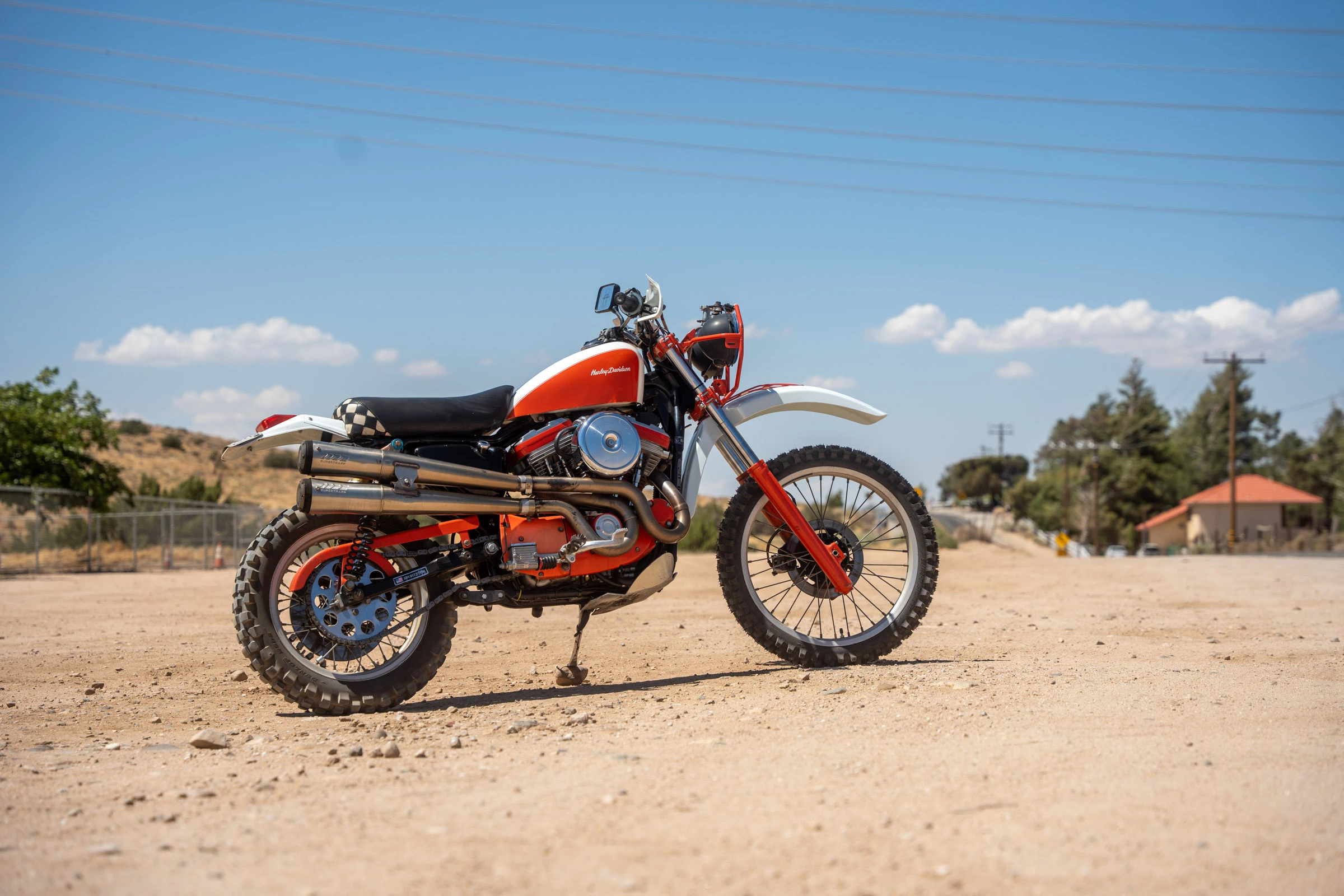
Historic Dual Sport Sportster from the cover of 1991 Hot Bike


Historic Dual Sport Sportster from the cover of 1991 Hot Bike

Editor’s Note: We’ve been fans of this Dual Sport Sportster ever since it graced the cover of Hot Bike back […]

The post Historic Dual Sport Sportster from the cover of 1991 Hot Bike appeared first on Hot Bike Magazine.

Saturday, December 21, 2024

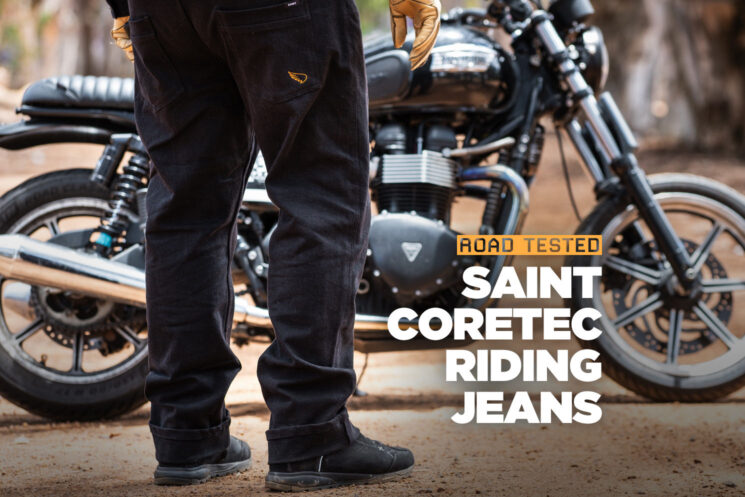
Road Tested: Saint Unbreakable Coretec armored motorcycle jeans


Road Tested: Saint Unbreakable Coretec armored motorcycle jeans

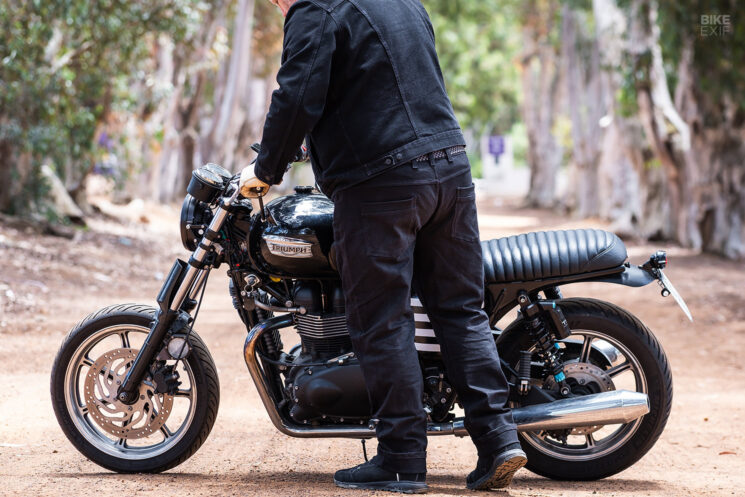
Saint Unbreakable Coretec armored motorcycle jeans reviewed
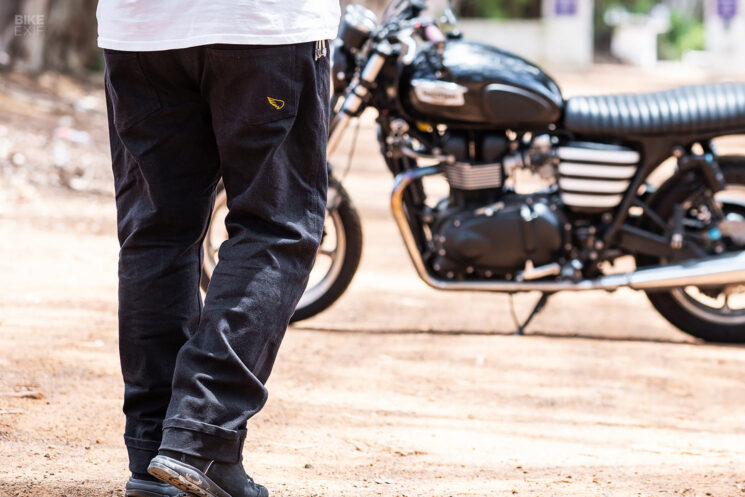
We’ve kept a close eye on Saint since they first hit the scene roughly a decade ago. The Australian gear company’s catalog has grown steadily over the years, but one product has remained core to their brand—riding jeans that are both stylish and protective.

Saint’s approach is to use high-tech fabrics with abrasion resistance baked in, producing single-layer garments rather than stacking regular denim over Kevlar. It makes their riding pants not only comfortable, but also stealthy enough to pass for casual wear. I’ve owned, worn, and ridden in several pairs of Saint motorcycle jeans, and they’ve all scored high.

Saint Unbreakable Coretec armored motorcycle jeans reviewed
The new Saint Unbreakable Coretec jeans epitomize this approach. At $385 [US] or $549 [Australian], Saint’s new premium denim is their most expensive—but it’s also their most protective, achieving a AAA CE safety rating. Saint sent me a pair in my regular size to see if they live up to the hype.

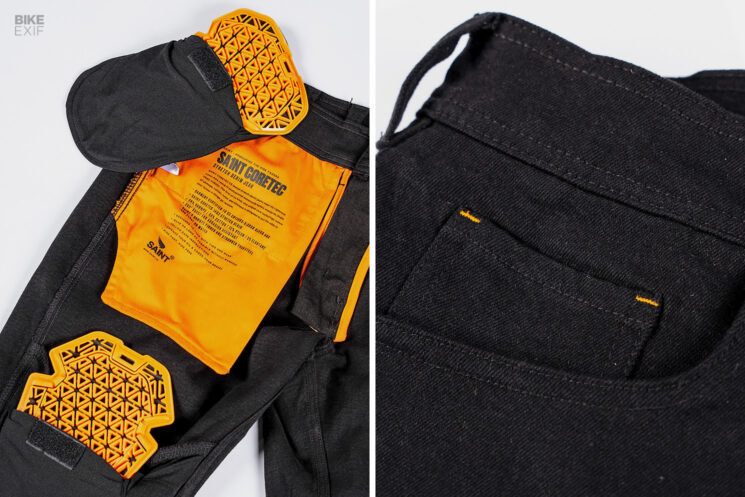
The Saint Unbreakable Coretec jeans get their name from the fabric that they employ; Coretec. It’s a composite material that uses a lycra core for flexibility, with an outer layer made of recycled cotton. Those two are woven together with UHMWPE (ultra-high-molecular-weight polyethylene)—a tough material that’s notable for its high tensile strength, impact resistance, and low friction coefficient.

Saint Unbreakable Coretec armored motorcycle jeans reviewed
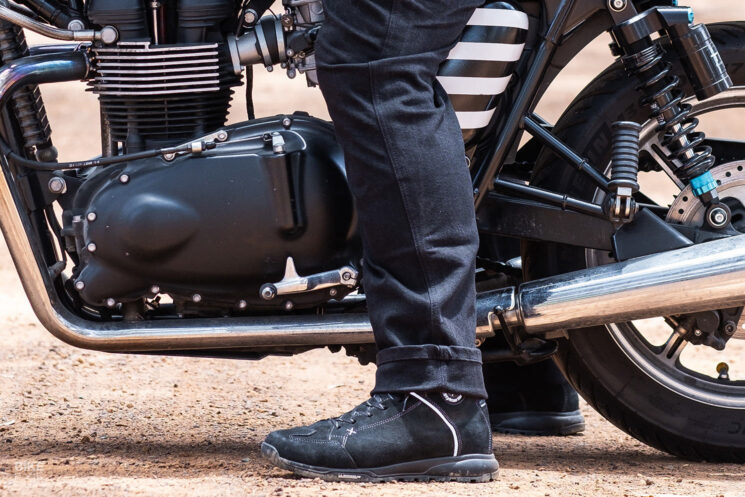
In the real world, that translates to a 14 oz denim that has the weighty vibe of selvage denim, but is less rigid, with a soft, brushed feel. I picked the Saint Unbreakable Coretec jeans in Saint’s straight fit (there’s a skinny option too), in my regular size, and they fit perfectly—with the caveat that they’re pretty long.

My size 40 jeans have an inseam of 35”, so turning them up is mandatory. Fit-wise, Saint’s straight cut sits loose without being overly baggy. The extra breathing room, plus the flexibility of the Coretec fabric, makes them supremely comfortable—both on and off the bike.

Saint Unbreakable Coretec armored motorcycle jeans reviewed
Ultra-thin D30 Ghost armor sits at the hips and the knees, offering CE Level 1 protection while being barely noticeable. That’s less protection than the Level 2 items in some of Saint’s other jeans, but the tradeoff is that the armor is light and malleable enough to be barely noticeable—without hurting the product’s overall AAA rating.

The pads are tucked into pockets made from a soft fabric that’s gentle against your skin, which is a boon for long days in the saddle. The knee pads were a little low for me on my first outing with the Unbreakable Coretec jeans—but I soon realized that there are two height options inside their pockets. A quick adjustment, and they’re now perfectly placed.

Saint Unbreakable Coretec armored motorcycle jeans reviewed
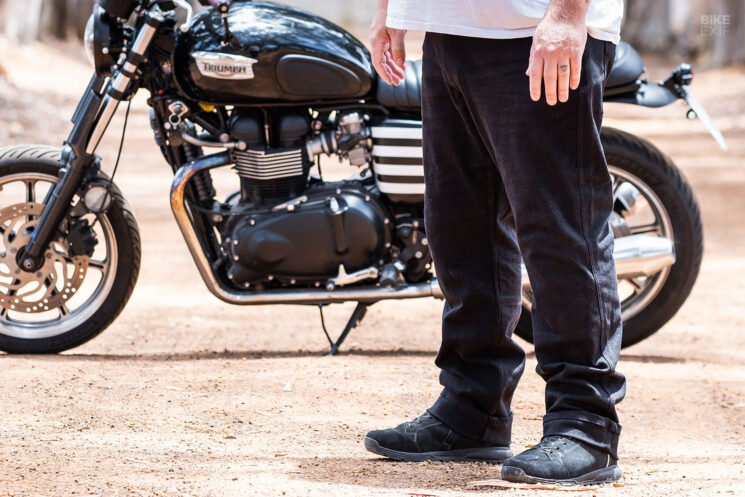
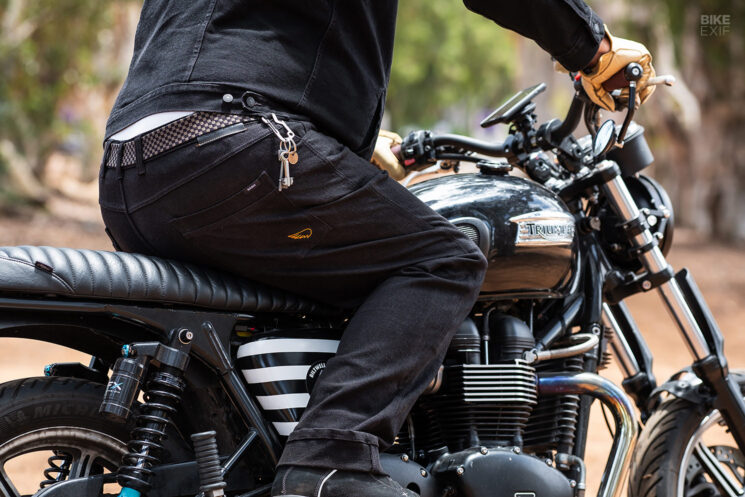
Aesthetically, the Saint Unbreakable Coretec jeans hit all the right notes. The denim is a dark, solid black—which should break in nicely if my other Saint jeans are any indication. There’s nothing fancy happening with the trimmings either—you get a standard five-pocket layout, with a few orange stitching highlights and minimal branding.

The only thing missing is a small detail that Saint has added to their Engineered model; a reflective strip inside the leg that reveals itself when you turn up the cuffs. It’s a small consideration, but it’s a great way to crank the safety aspect of these jeans up a notch. I’d add that the hefty denim seems like it’d feel toasty in extreme temperatures—but I haven’t worn them on a hot enough day to say for sure… yet.

Saint Unbreakable Coretec armored motorcycle jeans reviewed
Those notes aside, the Saint Unbreakable Coretec jeans’ biggest selling points are really style and comfort. I’m guilty of skimping on gear when it makes me feel constricted or when it makes me look like a squid. The fact that these jeans do neither, means that I’ll keep reaching for them, ride after ride.

Saint | Images by Wes Reyneke

Saint Unbreakable Coretec armored motorcycle jeans reviewed

Friday, December 20, 2024

Tokyo Triple: A 2010 Triumph Street Triple 675 café racer from Japan


Tokyo Triple: A 2010 Triumph Street Triple 675 café racer from Japan

2010 Triumph Street Triple 675 café racer, Tokyo, Japan
The mid-sized street bike market is one of the hottest on the planet, and the Triumph Street Triple is near the top of the list. It’s light, makes great power, sounds awesome, and seems generally great to live with. Heck, even the Street Triple’s most divisive feature—its distinctive dual headlight design—has grown on us over the years.

Not everyone is a fan of the styling though; you either love the Street Triple’s bug eyes, or you don’t. Junichi Nomura falls into the latter camp. After buying a stock standard 2010 Street Triple 675 from a friend, he spent a year giving the perky triple a facelift.

2010 Triumph Street Triple 675 café racer, Tokyo, Japan
“I’m not a professional bike builder,” Nomura-san admits. “I’m just a Japanese guy who likes to modify bikes in my garage at home.”

“I really love the café racer style, but I didn’t want a classic design. I wanted a relatively new, futuristic café racer—so I chose the Street Triple 675.”

2010 Triumph Street Triple 675 café racer, Tokyo, Japan
To kick things off, the twin headlight setup was discarded in favor of a single round LED and new brackets, courtesy of Amazon. The factory dashboard bracket also went, with a Motogadget Motoscope Mini used to simplify the cockpit area. The handlebars were replaced with Gilles Tooling clip-ons, after Junichi filled in the bar riser holes and repainted the top fork clamp for a factory look.

Matched to the new clip-ons are a radial Brembo RCS master cylinder, an Accosato clutch lever, and Domino grips. The micro switches are no-name-brand parts, but Junichi was still able to wire them in himself with full functionality. At the bottom of the forks, the factory Nissin calipers were exchanged for Brembo items to provide gobs of stopping power.

2010 Triumph Street Triple 675 café racer, Tokyo, Japan
A new subframe was fabricated by Junichi’s favorite workshop, and is topped with a universal seat kit that he bought online. Reminiscent of a Ducati Imola-style seat and adorned with a black leather seat, it pairs perfectly with the modern lines on the fuel tank. A Highsider LED taillight was recessed into the back, keeping the rear end nice and clean, with Highsider turn signals fitted at both ends of the bike.

The battery was replaced with a lightweight Lithium unit and packed under the seat, and the coolant overflow system was redesigned to work with a small bottle (originally designed for a liquid-cooled gaming computer). A CNC-machined fuel cap sits on top of the stock fuel tank.

2010 Triumph Street Triple 675 café racer, Tokyo, Japan
The custom Nitron rear shock was originally made for a Triumph Daytona 675, but it bolted straight onto the Street Triple. But first, Junichi sent away for a new spring (matched to his weight), and got Nitron to paint it black instead of their signature blue. BabyFace rear-set footpegs were added too, plus sticky Dunlop Sportmax tires to maintain maximum grip.

With assembly completed, Junichi finished off the engine (that already produces more than enough power) with a custom titanium exhaust. The Frankenstein system uses a pie-cut connector that was adapted to fit on sinuous three-into-one Arrow headers, plus an Akrapovič muffler from a Suzuki GSX-R750.

2010 Triumph Street Triple 675 café racer, Tokyo, Japan
Deep navy blue paint was used to finish off the Triumph Street Triple 675, delicately decorated with stunning twin silver pinstripes that trace the lines of the bodywork. For someone who doesn’t consider themselves a professional bike builder, Nomura-san has done a fantastic job. The finished product is lithe and purposeful—perfect for zipping through the streets of Tokyo.

Images by Junichi Nomura

2010 Triumph Street Triple 675 café racer, Tokyo, Japan

Tuesday, December 17, 2024

Have Fun, Cheetah Style: A Buell Blast flat tracker from Japan


Have Fun, Cheetah Style: A Buell Blast flat tracker from Japan

Buell Blast flat tracker by Cheetah, Tokyo, Japan
Few motorcycles can claim the notoriety of the ill-fated Buell Blast. Propelled by half a Sportster engine and aimed at beginner riders, the Blast was such a disappointment that its creator, Erik Buell, signaled the end of its production by publicly tossing one into a crusher. Then, to drive the point home, he offered a limited run of crushed and autographed Buell Blast ‘cubes’ for sale.

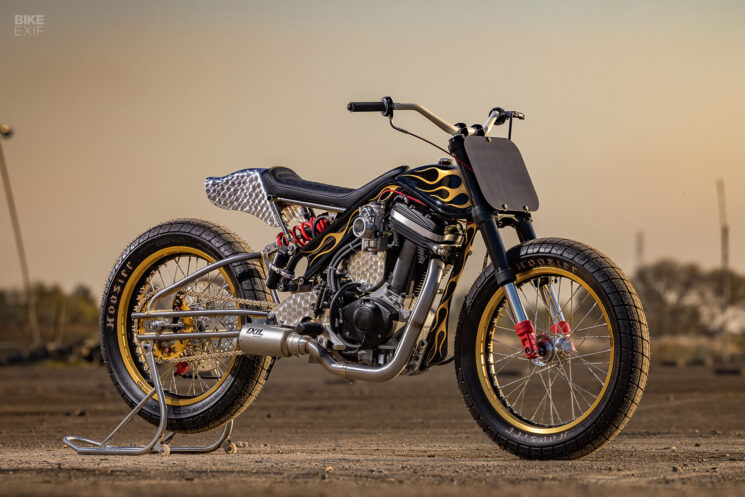
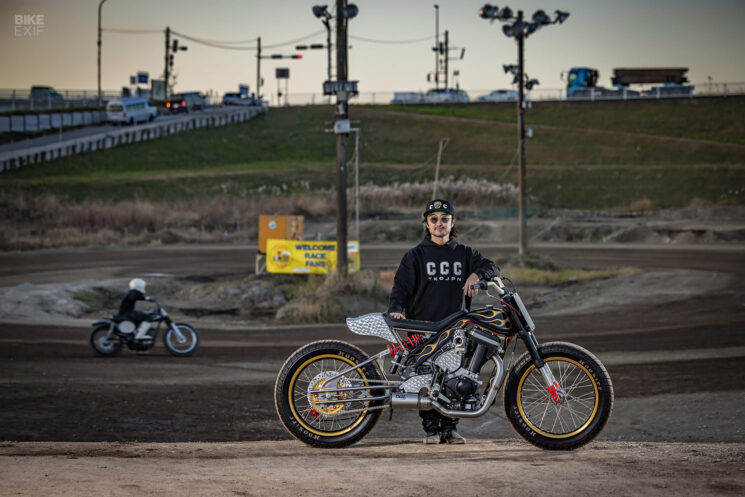
The Buell Blast’s infamy—and rarity—are precisely what tempted Toshiyuki ‘Cheetah’ Osawa to customize it. Based in Tokyo, Japan, Osawa-san is the brains behind the ‘Have Fun’ flat track racing event. He also builds some of the most imaginative flat trackers around.

Buell Blast flat tracker by Cheetah, Tokyo, Japan
The Blast is hard to find in Japan, so Cheetah imported one from the USA earlier this year. “Single-cylinder models are often used in flat track racing, so I thought it would be interesting to make a racer based on this,” he tells us. “I wanted to build a racer that nobody had ever made before; a flat track racer that encapsulates the idea of a chopper.”

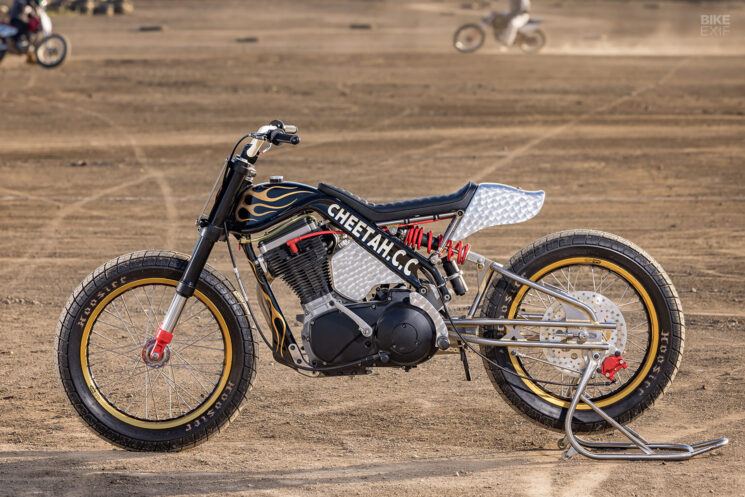
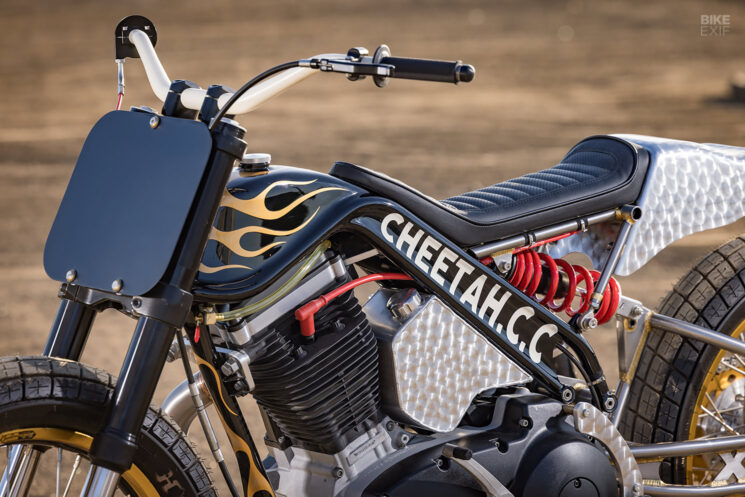
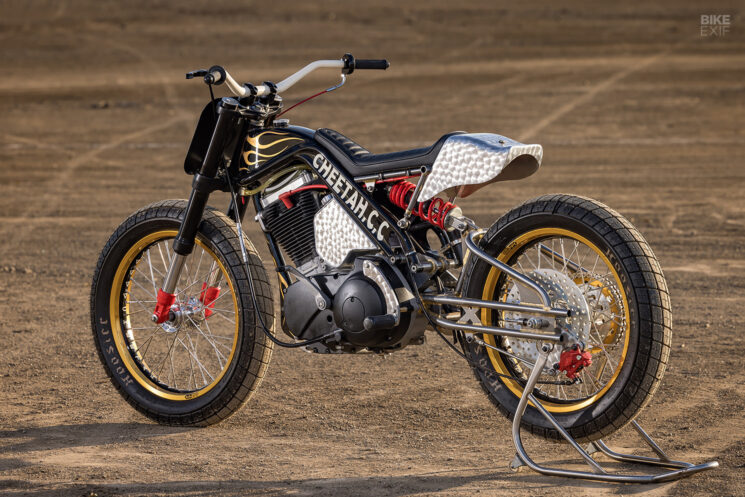
Cheetah stripped the Buell Blast down to its engine and began designing a bespoke chassis. First, he fabricated a petite fuel tank and elegant tubular frame backbone. Then he combined the two using traditional chopper molding methods.

Buell Blast flat tracker by Cheetah, Tokyo, Japan
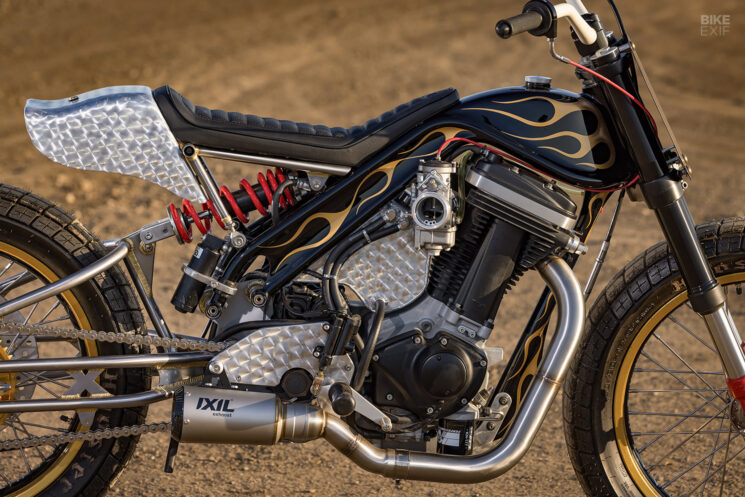
The final monocoque went off to a friend, S Paint, for a coat of black paint. Next, Cheetah laid down a set of flames by hand—referencing 70s and 80s choppers and drag racers. “I wanted to try the combination of molding and flames on a racer with a decent ride height,” he explains.

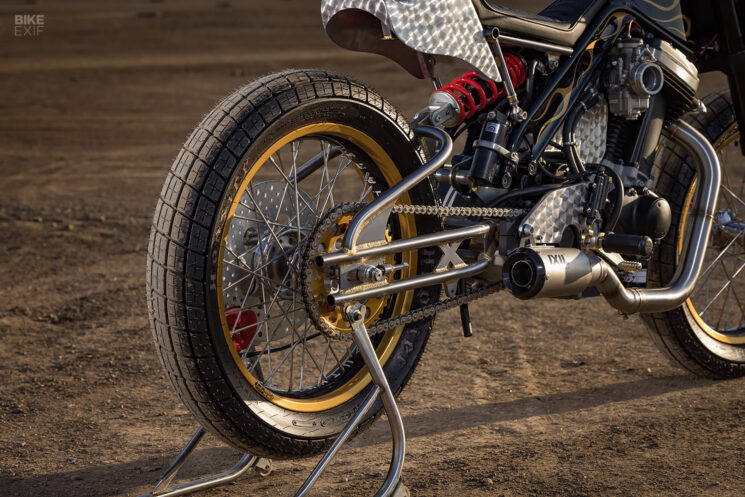
Further back, Cheetah fabricated a subframe and swingarm out of chromoly tubing. All of the welds use a traditional bronze brazing technique—something that he taught himself a few years ago. The twin-tube swingarm design was inspired by a classic Arlen Ness design, with X-shaped gussets paying homage to the A-shaped items on the original Ness version.

Buell Blast flat tracker by Cheetah, Tokyo, Japan
The juxtaposition of the slick molded front end, against the chromoly brazed rear section, is inspired—a harmonious blend of different styles from different eras. Cheetah drives the point home by adding a third style, showcasing his metalworking skills with a custom tail cowl, oil tank, and foot control brackets that all bear a swirled finish. A perforated seat, upholstered by Atelier Tee, runs across the top of the bodywork.

Buell Blast flat tracker by Cheetah, Tokyo, Japan
There’s nothing left of the Buell Blast’s running gear either. It now rolls on 19” Sun Rims hoops, shod with Hoosier flat track tires. The forks and rear shock are WP Suspension components, the rear suspension mounts are custom, and the rear brake uses a Brembo caliper.

A set of Cheetah flat track handlebars sit up top, held in place by aftermarket risers. They’re fitted with a Domino throttle, fresh grips, and a short clutch lever. Lower down, Cheetah modified the shift lever to create clearance for boot-out riding, and added Bates foot pegs.

Buell Blast flat tracker by Cheetah, Tokyo, Japan
A Dell’Orto carb feeds the motor, with a custom exhaust header and an Ixil muffler expelling gasses. The exhaust’s flawless routing and the asymmetrical foot peg placement prove that this machine’s been built to ride in anger—but its myriad finishes and engineering techniques speak to Cheetah’s creativity.

Black, silver, gold, and red sounds like an over-stuffed palette, but it works spectacularly well. The gold flame graphics are matched by the gold rims, which, in turn, wear subtle graphics on the inside. Red is used sparingly; on the front forks, rear shock spring, rear brake caliper, throttle cable, and spark plug lead.

Buell Blast flat tracker by Cheetah, Tokyo, Japan
Stacked with thoughtful details (like the way the oil tank is tucked in behind the cylinder head), and flawlessly blending several genres into one machine, Cheetah’s Buell flat tracker is a blast of fresh air.

Toshiyuki ‘Cheetah’ Osawa Instagram | Images by, and with sincere thanks to, Kazuo Matsumoto

Buell Blast flat tracker by Cheetah, Tokyo, Japan